Colombians have always excelled abroad. It doesn’t really matter where we go, or even if we don’t want to demonstrate it, because according to foreigners we always have that “seasoning” that gives us away. And if we think about it a little, it’s not very difficult to find out why. After all, not in vain we have a culture that is characterized by being warm, spontaneous, outgoing and cheerful. Some clear examples of this are the multiple parties and carnivals we celebrate, the fans of the Colombia team or some of our most carefree customs (such as the fact that a man says “my love” to a woman, even if he doesn’t know her). These characteristics have prevailed in our society for longer than we may remember, and although that might explain why we interact with each other based on them is something completely natural, among foreigners it’s something that never ceases to surprise and be exceptional. And it’s not for less, especially when things between them are handled diametrically differently. The American community, for example, is one of the societies that can best account for it. They are strict and independent, and despite they are friendly, they are not characterized by being the most expressive. That’s why, when bringing together two people from these cultures, mutual understanding and adaptation is vital for the relationship (regardless of what type) to work. Chris, a 27-year-old American citizen who came from exchange to Colombia to study at North University, can attest to this.
Chris Miller Experience:
«I came to Barranquilla nine months ago due to an academic exchange that I will complete shortly, and the truth is that I cannot be more grateful with all the experiences that this city has allowed me to live. I can safely say that thanks to this I have changed my perspective on many issues, and I have even felt at home, something that until now had not happened to me anywhere else. However, not everything has been rosy. On the contrary, at the beginning it took me a very good time to adapt to how things are done here. For example, one of the customs that struck me the most when I arrived was that of punctuality. For me it was very shocking to see how my classmates arrived five, ten or even fifteen minutes after class started, precisely because where I come from punctuality is a key factor in determining the level of seriousness and good education of a person, and also establishes a certain period of time that is organized within an agenda. That was another factor that shocked me too much: the flexibility with which the agenda is managed. Despite the time I have been here, the truth is that I still cannot understand how my classmates manage to do different activities at the same time (like eating and reading the text of the next class or doing a homework while talking about weekend plans). I tried, I promise, but honestly it has been impossible for me to imitate their work rhythm. However, I know that such difficulty is due to I was raised in an environment that organizes a specific time for each activity, something that apparently is also used here, but in a much more modifiable and optional way. Among other things, it also cost me a bit how to relate to others, but not because I was shy, but because here people behave in a more outgoing way than I am usually used to. However, that doesn’t bother me. On the contrary, I like it and it seems nice. Of the rest, all good».
After reading Chris’s experience we could easily conclude that all the changes to which he had to adapt were the product of the culture change. But, have you ever wondered what are the parameters under which each specific culture works? If your answer is yes, according to an economic development study called «The Lewis Model», all countries (and their respective cultures) can be classified into three categories:
Linear-actives — those who plan, schedule, organize, pursue action chains, do one thing at a time. Germany, Switzerland, and the U.S. are in this group.
Multi-actives — those lively, loquacious cultures that do many things at once, planning their priorities not according to a time schedule, but according to the relative thrill or importance that each appointment brings with it. Italy, Latin America and Arab countries are members of this group.
Reactives — those cultures that prioritize courtesy and respect, listening quietly and calmly to their interlocutors and reacting carefully to the other side’s proposals. Vietnam, Japan, China and Korea are in this group.
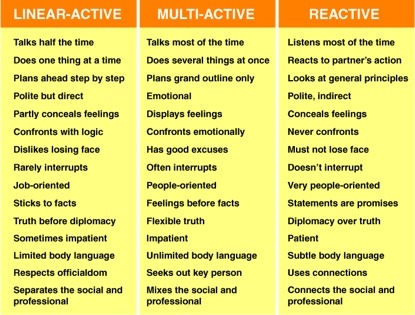
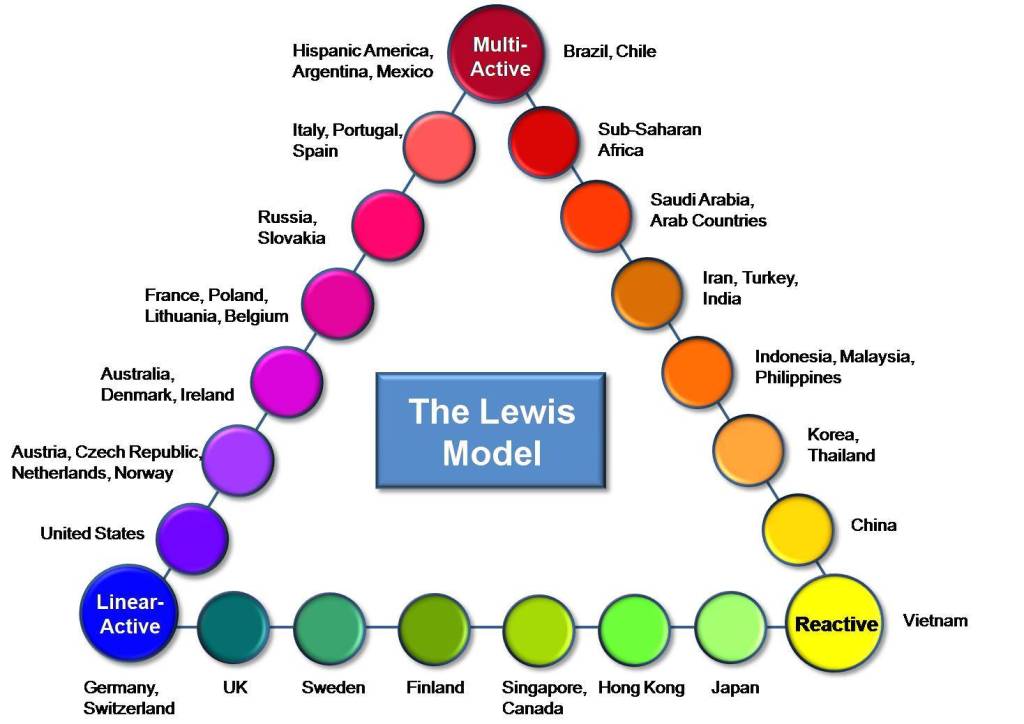
Well, now that you saw how countries and cultures are classified according to this model you will have the ability to explain in more depth what is behind Chris’s entire adaptation process, and even what can be expected of each person according to the culture or country to which it belongs. Therefore, I end today’s chapter. I hope you liked it and continue to accompany me on this journey #breakingbarriers. Until next time.
 United States Culture: Breaking Barriers