My name is María Belén Chicangana Salas, but I’m better known as Mabe. I was born in the beautiful and magical city of Cartagena 18 years ago, but I have lived in Barranquilla since I was 11, so I love both cities and I consider them indistinctly as my home. I am currently studying Social Communication and Journalism at the North University, where I expect to graduate in 2022.
A curious fact about me is that one the reasons why I chose my career was precisely because of the opportunity it offers me to travel and get to know other cultures, an activity that has always fascinated me. That`s why the idea of creating this blog could not fascinate me more. My job in this case will be to conduct an investigation about the stereotypes that surround the American community, and how reliable these are when comparing them to reality. So, if you are interested in opening your mind and knowing more about this culture, I invite you to subscribe and accompany me on this trip discovering the truths that are behind the stereotypes that the society have instilled in us about this culture. Hope you like it.
Att: Mabe
PD: Remember, we travel to change, not our place, but our ideas.
A subculture is a group of people within a culture that differentiates itself from the parent culture to which it belongs, often maintaining some of its founding principles. Subcultures develop their own norms and values regarding cultural, political and sexual matters, and are also part of society while keeping these specific characteristics intact.
Thousands of subcultures exist within the United States. Some subcultures are united by shared experiences, while others are formed by members who possess traits or preferences that differ from the majority of a society’s population. In addition, it should be noted that, in the United States, teenagers often form subcultures to develop a shared youth identity. But even as members of a joint subculture band, they still identify and participate in society in general.
Some examples of Subcultures in the United States can be:
Bikers:
A motorcycle club, or motorcycle gang, is a group of individuals whose primary interest and activities involve motorcycles. A motorcycle group can range as clubbed groups of different bikes or bikers who own same model of vehicle like the Harley Owners Group. Most clubs are either organized around a brand or a type of riding (e.g. touring).
Characteristics:
Bikers began in the 1940’s and 1950’s.
They were mainly World War II veterans that wanted to feel the freedom of the open road and not be held down by starting a family.
The early bikers began to show rebellion and resistance against the mainstream views by creating their own subculture.
Bikers are known to wear black leather jackets and boots accompanied by a pair of denim jeans that are sometimes distressed.
Here is a YouTube video created by a motorcyclist that explains his thoughts and emotions by traveling on the open road.
Hipsters:
Nonconformists. Progressives. Promoters of social change. Intelligent conversationalists. These are all descriptions of the hipster subculture, which is mostly comprised of white 20 to 30-year-olds. They are highly-educated and sociopolitically informed millennials, who grew up in middle to upper class families, and live in urban areas. Many have gone to college and graduated with a degree in the liberal arts.
Hipsters typically listen to indie rock and alternative music, have politically liberal stances, buy organic foods and products, and protest popular, highly-commercialized clothing brands by shopping at thrift stores. Hipsters pride themselves on their up-to-date knowledge of social issues, intelligence, creativity, and appreciation of art, music and food. The hipster subculture has roots all the way back to the 1940s.
Although the country has made significant progress in terms of gender equality and women’s rights, these have been insufficient and too slow. As a clear example of this, women still have 20 percentage points less than men in labor participation, 5 more unemployment points, dedicate twice as much time to the care economy, and still have very little presence in public management positions and of the economic sector.
In contrast, according to the annual World Economic Forum report on gender gaps, in Colombia there is less and less difference in education. This statement is based on the fact that those who graduate from higher education are currently 54% women. Nevertheless, in economic and political terms, the wage gap does not offer such an encouraging picture. This is because, despite the progress that has been made, Women with the same training and the same position as men continue to receive 18% less salary compared to them.
United States
Although no country in the world has managed to close the gender gap completely, the US doesn’t belong to the small group of countries that are closer (or less distant) to achieve it. According to the 2017 Global Gender Gap Report of the Davos World Forum, the US is ranked 49th out of the 144 countries covered by the Report. Although this is similar to the 2016 edition, in which the US report was ranked 452 out of 144 countries, it is a very important setback if we take into account the 2015 report, in which the US was ranked 28th of the total of 145 countries analyzed. It is, therefore, a drop of 21 places in the ranking.
The data is even worse if we refer to the sub-index of political empowerment, in which the US goes down to the 96th position of the ranking, falling more than 20 places compared to the previous year. The low presence of women in this area is common to the legislative branch (House of Representatives and Senate) and the executive branch (federal and state).
Although the US has managed to close the gender gap in education (along with 26 other countries, among which are Colombia) and is ranked 19th in the ranking of the economic opportunity sub-index (which measures the percentage of women in the active population, salary equality and the professional positions they occupy), the low result in terms of political empowerment reflects that, despite the fact that equality between men and women has been achieved in education, barriers persist for women Access political power.
Also, according to available data, 4 of the 410 charges proposed so far by President Trump that require Senate approval, only 21% are women, compared to 79% of men.
Hofstede’s cultural dimensions theory is a framework for cross cultural communication, developed by Geert Hofstede. It shows the effects of a society’s culture on the values of its members, and how these values relate to behavior, using a structure derived from factor analysis.
The original theory proposed four dimensions along which cultural values could be analyzed: individualism-collectivism; uncertainly avoidance; power distance (strength of social hierarchy) and masculinity-femininity (task-orientation versus person-orientation). Independent research in Hong Kong led Hofstede to add a fifth dimension, long-term orientation, to cover aspects of values not discussed in the original paradigm. In 2010, Hofstede added a sixth dimension, indulgence versus self-restraint.
Hofstede’s work established a major research tradition in cross cultural psichology and has also been drawn upon by researchers and consultants in many fields relating to international business and communication. The theory has been widely used in several fields as a paradigm for research, particularly in cross-cultural psychology, international management, and cross-cultural communication. It continues to be a major resource in cross-cultural fields. It has inspired a number of other major cross-cultural studies of values, as well as research on other aspects of culture, such as social beliefs.
That is why, taking into account the importance of this theory for the analysis of different cultures, I will proceed to contrast the American culture with the Colombian culture according to its official parameters.
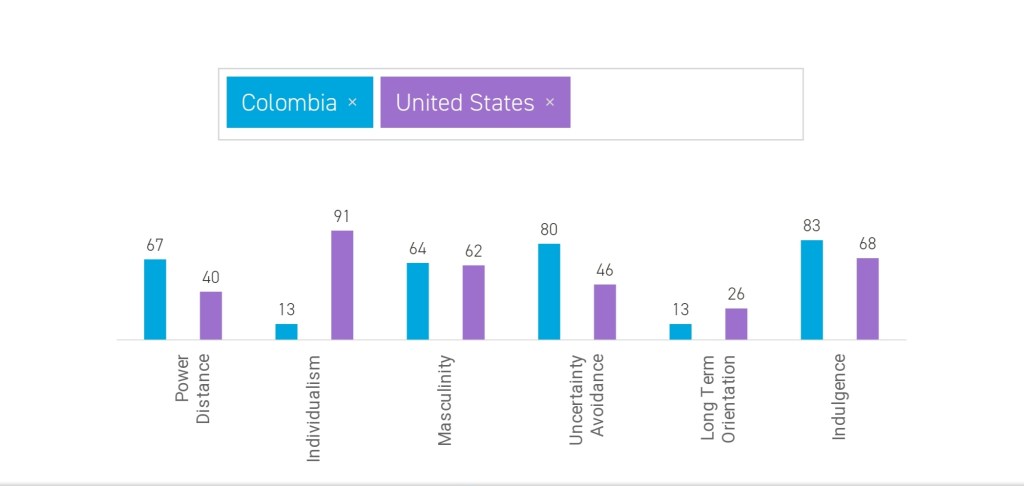
Power Distance
C: 67
US: 40
Power Distance is defined as the extent to which the less powerful members of institutions and organisations within a country expect and accept that power is distributed unequally.
At 67 Colombia scores high on the scale of the PDI, so it’s a society that believes that inequalities amongst people are simply a fact of life. This inequality is accepted in all layers of society, so, for example, a union leader will have a lot of concentrated power compared to his union management team, and they in turn will have more power than other union members. However, it should be noted that this perspective may not necessarily be based on a conformist spirit or lack of desire to move forward. On the contrary, the entrepreneurial spirit or the desire to overcome it may be present, but that corruption and favoritism simply do not allow them to develop, which is why Colombian society has generated this conformist vision of inequality.
The United States, on the other hand, has a score of 40, which indicates that American society tolerates less inequality compared to Colombian society. However, this may be due to the fact that in that country the rights of people are more recognized.
Individualism
C: 13
US: 91
The fundamental issue addressed by this dimension is the degree of interdependence a society maintains among its members. It has to do with whether people´s self-image is defined in terms of “I” or “We”. In Individualist societies people are supposed to look after themselves and their direct family only. In Collectivist societies people belong to ‘in groups’ that take care of them in exchange for loyalty.
At a score of 13 Colombia is amongst the lowest Individualist scores; in other words, it lies amongst the most collectivistic cultures in the world, beaten only by Ecuador, Panama and Guatemala.
Since the Colombians are a highly collectivistic people, belonging to an in-group and aligning yourself with that group’s opinion is very important. Combined with the high scores in PDI, this means that groups often have their strong identities tied to class distinctions. Loyalty to such groups is paramount and often it is through “corporative” groups that people obtain privileges and benefits which are not to be found in other cultures. The above makes a lot of sense considering how clacist our society remains today, which is why the behavior, progress and treatment of each individual depends on the social group in which he was born, and to which it is due.
In contrast, the United States presents a diametrically different picture with a score of 91, which indicates that its citizens are practically completely individualistic, what means that they only care about their family or closest friends.
Masculinity
C: 64
US: 62
A high score (Masculine) on this dimension indicates that the society will be driven by competition, achievement and success, with success being defined by the winner / best in field – a value system that starts in school and continues throughout organisational life.
A low score (Feminine) on the dimension means that the dominant values in society are caring for others and quality of life. A Feminine society is one where quality of life is the sign of success and standing out from the crowd is not admirable. The fundamental issue here is what motivates people, wanting to be the best (Masculine) or liking what you do (Feminine).
With a score of 64 and 62, respectively, both Colombia and the United States are male societies slightly separated by two points of difference
With a score of 64 and 62, respectively, both Colombia and the United States are male societies separated slightly by two points of difference. Such a similarity may be due to the fact that, despite the fact that in both the quality of life is totally different, competitiveness is an important factor in being recognized and benefited in society.
Uncertainly Avoidance
C: 80
US: 46
The dimension Uncertainty Avoidance has to do with the way that a society deals with the fact that the future can never be known: should we try to control the future or just let it happen? This ambiguity brings with it anxiety and different cultures have learnt to deal with this anxiety in different ways. The extent to which the members of a culture feel threatened by ambiguous or unknown situations and have created beliefs and institutions that try to avoid these is reflected in the score on Uncertainty Avoidance.
At 80 Colombia has a high score on Uncertainty Avoidance, which means that as a nation we are seeking mechanisms to avoid ambiguity. Emotions are openly expressed; there are (extensive) rules for everything and social conservatism enjoys quite a following. This is also reflected in religion, which is respected, followed by many and conservative.
The United States, on the other hand, has a score of 46, which indicates that its society prefers to face to a greater or lesser extent the anxiety that ambiguity brings, causing religion or conservative traditions to be relegated to the background in some occasions to be replaced by more progressive ideas.
This may be due to the fact that, in comparison with Colombia, American society is secular in an integral way, something in which Colombian society is still working.
Long Term Orientation
C: 13
UE: 26
This dimension describes how every society has to maintain some links with its own past while dealing with the challenges of the present and future, and societies prioritise these two existential goals differently. Normative societies. which score low on this dimension, for example, prefer to maintain time-honoured traditions and norms while viewing societal change with suspicion. Those with a culture which scores high, on the other hand, take a more pragmatic approach: they encourage thrift and efforts in modern education as a way to prepare for the future.
With a low score of 13, Colombian culture is classified as normative. People in such societies have a strong concern with establishing the absolute Truth; they are normative in their thinking. They exhibit great respect for traditions, a relatively small propensity to save for the future, and a focus on achieving quick results. This makes sense if we analyze that in the country the majority of the population remains Catholic, as well as conservative.
The United States, on the other hand, has a slightly more challenging society, so it has a score of 26, indicating that it tends to reveal itself a little more against the status quo.
Indulgence
C: 83
US: 68
This dimension is defined as the extent to which people try to control their desires and impulses, based on the way they were raised. Relatively weak control is called “Indulgence” and relatively strong control is called “Restraint”. Cultures can, therefore, be described as Indulgent or Restrained.
Scoring a very high 83 in this dimension, Colombia is shown to be an Indulgent country, something that can be based on how volatile or carefree we can be with the handling of things. The United States, on the other hand, is not far behind, since it also shows signs of being a society, although less «relaxed», almost equally free in the enjoyment of its lifestyle.
Colombians have always excelled abroad. It doesn’t really matter where we go, or even if we don’t want to demonstrate it, because according to foreigners we always have that “seasoning” that gives us away. And if we think about it a little, it’s not very difficult to find out why. After all, not in vain we have a culture that is characterized by being warm, spontaneous, outgoing and cheerful. Some clear examples of this are the multiple parties and carnivals we celebrate, the fans of the Colombia team or some of our most carefree customs (such as the fact that a man says “my love” to a woman, even if he doesn’t know her). These characteristics have prevailed in our society for longer than we may remember, and although that might explain why we interact with each other based on them is something completely natural, among foreigners it’s something that never ceases to surprise and be exceptional. And it’s not for less, especially when things between them are handled diametrically differently. The American community, for example, is one of the societies that can best account for it. They are strict and independent, and despite they are friendly, they are not characterized by being the most expressive. That’s why, when bringing together two people from these cultures, mutual understanding and adaptation is vital for the relationship (regardless of what type) to work. Chris, a 27-year-old American citizen who came from exchange to Colombia to study at North University, can attest to this.
Chris Miller Experience:
«I came to Barranquilla nine months ago due to an academic exchange that I will complete shortly, and the truth is that I cannot be more grateful with all the experiences that this city has allowed me to live. I can safely say that thanks to this I have changed my perspective on many issues, and I have even felt at home, something that until now had not happened to me anywhere else. However, not everything has been rosy. On the contrary, at the beginning it took me a very good time to adapt to how things are done here. For example, one of the customs that struck methe most when I arrived was that of punctuality. For me it was very shocking to see how my classmates arrived five, ten or even fifteen minutes after class started, precisely because where I come from punctuality is a key factor in determining the level of seriousness and good education of a person, and also establishes a certain period of time that is organized within an agenda. That was another factor that shocked me too much: the flexibility with which the agenda is managed. Despite the time I have been here, the truth is that I still cannot understand how my classmates manage to do different activities at the same time (like eating and reading the text of the next class or doing a homework while talking about weekend plans). I tried, I promise, but honestly it has been impossible for me to imitate their work rhythm. However, I know that such difficulty is due to I was raised in an environment that organizes a specific time for each activity, something that apparently is also used here, but in a much more modifiable and optional way. Among other things, it also cost me a bit how to relate to others, but not because I was shy, but because here people behave in a more outgoing way than I am usually used to. However, that doesn’t bother me. On the contrary, I like it and it seems nice. Of the rest, all good».
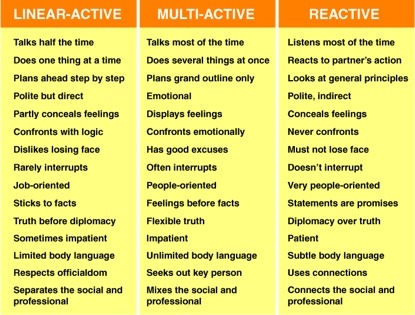
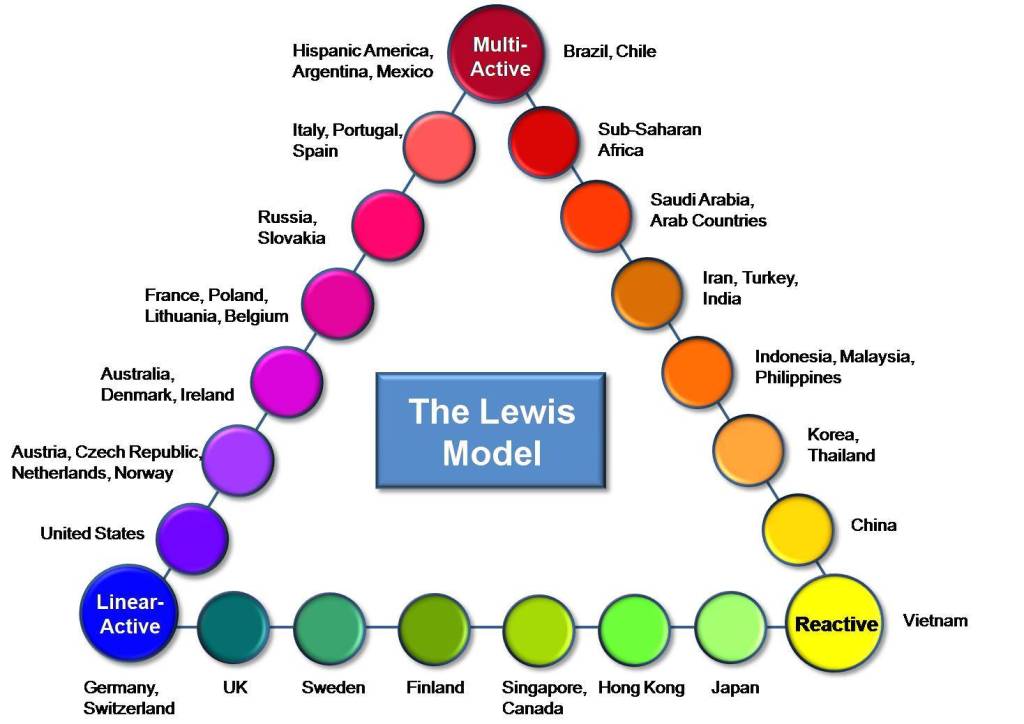
After reading Chris’s experience we could easily conclude that all the changes to which he had to adapt were the product of the culture change. But, have you ever wondered what are the parameters under which each specific culture works? If your answer is yes, according to an economic development study called «The Lewis Model», all countries (and their respective cultures) can be classified into three categories:
Linear-actives — those who plan, schedule, organize, pursue action chains, do one thing at a time. Germany, Switzerland, and the U.S. are in this group.
Multi-actives — those lively, loquacious cultures that do many things at once, planning their priorities not according to a time schedule, but according to the relative thrill or importance that each appointment brings with it. Italy, Latin America and Arab countries are members of this group.
Reactives — those cultures that prioritize courtesy and respect, listening quietly and calmly to their interlocutors and reacting carefully to the other side’s proposals. Vietnam, Japan, China and Korea are in this group.
Well, now that you saw how countries and cultures are classified according to this model you will have the ability to explain in more depth what is behind Chris’s entire adaptation process, and even what can be expected of each person according to the culture or country to which it belongs. Therefore, I end today’s chapter. I hope you liked it and continue to accompany me on this journey #breakingbarriers. Until next time.
According to the definition contained in the RAE, a stereotype consists of an image or idea that is accepted by most people as representative of a certain group, often in a preconceived way and without theoretical foundations.
In the case of US citizens, some of the stereotypes that most characterize them are:
Xenophobic: Due to the strict immigration policies that President Donald Trump is currently establishing in the United States (coupled with his anti-immigrant speech), Americans are considered as people who discriminate against or strongly reject anyone who is not native of their country (especially Mexicans and Muslims).
Racists: Due to the various cases of abuse of authority by the police against the African-American community, as well as the emergence of extremist groups such as the Ku Klux Klan and the various signs of hatred by certain people of white skin, it’s considered that Americans can become quite racist.
Nationalists: Since many national pride festivals are celebrated in the United States (in addition to being recognized as a leader in a large number of camps), its citizens are considered to be quite nationalistic.
Lovers of junk food: The United States presents serious problems of obesity due to malnutrition (in addition to being recognized as the cradle of processed food), which is why its citizens are considered fast food lovers.
Punctual: Because it’s always seen that Americans try to get everywhere on time.
Inflexible: Since for them “the rules are the rules”, and that’s all.
Cold: Compared to the Latino community, Americans tend to be seen as “cold” or very formal in their treatment.
Blondes, with light eyes and white skin: Although there is a great diversity of races in the United States, there is still a prototype that the average American is blond, with light eyes and white skin.
Lovers of American football, basketball and baseball: Since in the United States there are very famous associations of these sports such as the NBA, NFL and MLB.



 United States Culture: Breaking Barriers