Hofstede’s cultural dimensions theory is a framework for cross cultural communication, developed by Geert Hofstede. It shows the effects of a society’s culture on the values of its members, and how these values relate to behavior, using a structure derived from factor analysis.
The original theory proposed four dimensions along which cultural values could be analyzed: individualism-collectivism; uncertainly avoidance; power distance (strength of social hierarchy) and masculinity-femininity (task-orientation versus person-orientation). Independent research in Hong Kong led Hofstede to add a fifth dimension, long-term orientation, to cover aspects of values not discussed in the original paradigm. In 2010, Hofstede added a sixth dimension, indulgence versus self-restraint.
Hofstede’s work established a major research tradition in cross cultural psichology and has also been drawn upon by researchers and consultants in many fields relating to international business and communication. The theory has been widely used in several fields as a paradigm for research, particularly in cross-cultural psychology, international management, and cross-cultural communication. It continues to be a major resource in cross-cultural fields. It has inspired a number of other major cross-cultural studies of values, as well as research on other aspects of culture, such as social beliefs.
That is why, taking into account the importance of this theory for the analysis of different cultures, I will proceed to contrast the American culture with the Colombian culture according to its official parameters.
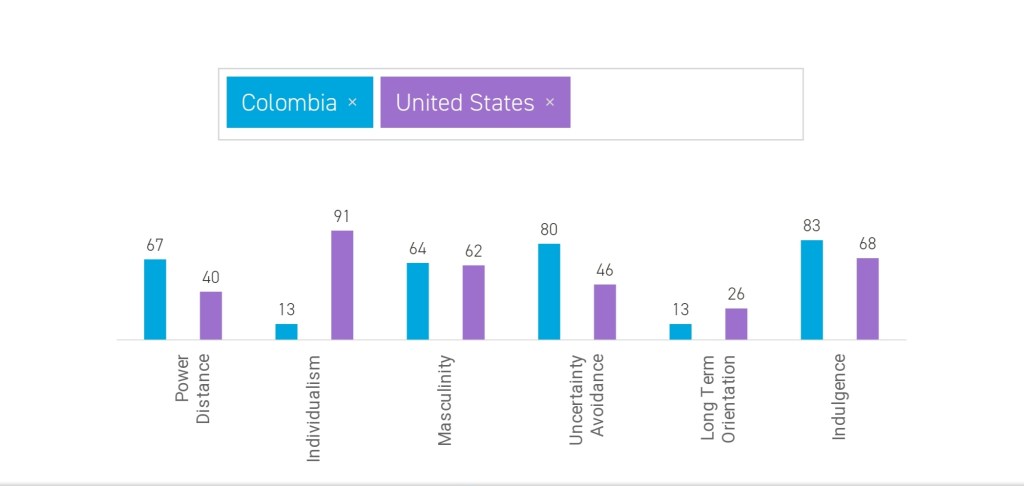
Power Distance
C: 67
US: 40
Power Distance is defined as the extent to which the less powerful members of institutions and organisations within a country expect and accept that power is distributed unequally.
At 67 Colombia scores high on the scale of the PDI, so it’s a society that believes that inequalities amongst people are simply a fact of life. This inequality is accepted in all layers of society, so, for example, a union leader will have a lot of concentrated power compared to his union management team, and they in turn will have more power than other union members. However, it should be noted that this perspective may not necessarily be based on a conformist spirit or lack of desire to move forward. On the contrary, the entrepreneurial spirit or the desire to overcome it may be present, but that corruption and favoritism simply do not allow them to develop, which is why Colombian society has generated this conformist vision of inequality.
The United States, on the other hand, has a score of 40, which indicates that American society tolerates less inequality compared to Colombian society. However, this may be due to the fact that in that country the rights of people are more recognized.
Individualism
C: 13
US: 91
The fundamental issue addressed by this dimension is the degree of interdependence a society maintains among its members. It has to do with whether people´s self-image is defined in terms of “I” or “We”. In Individualist societies people are supposed to look after themselves and their direct family only. In Collectivist societies people belong to ‘in groups’ that take care of them in exchange for loyalty.
At a score of 13 Colombia is amongst the lowest Individualist scores; in other words, it lies amongst the most collectivistic cultures in the world, beaten only by Ecuador, Panama and Guatemala.
Since the Colombians are a highly collectivistic people, belonging to an in-group and aligning yourself with that group’s opinion is very important. Combined with the high scores in PDI, this means that groups often have their strong identities tied to class distinctions. Loyalty to such groups is paramount and often it is through “corporative” groups that people obtain privileges and benefits which are not to be found in other cultures. The above makes a lot of sense considering how clacist our society remains today, which is why the behavior, progress and treatment of each individual depends on the social group in which he was born, and to which it is due.
In contrast, the United States presents a diametrically different picture with a score of 91, which indicates that its citizens are practically completely individualistic, what means that they only care about their family or closest friends.
Masculinity
C: 64
US: 62
A high score (Masculine) on this dimension indicates that the society will be driven by competition, achievement and success, with success being defined by the winner / best in field – a value system that starts in school and continues throughout organisational life.
A low score (Feminine) on the dimension means that the dominant values in society are caring for others and quality of life. A Feminine society is one where quality of life is the sign of success and standing out from the crowd is not admirable. The fundamental issue here is what motivates people, wanting to be the best (Masculine) or liking what you do (Feminine).
With a score of 64 and 62, respectively, both Colombia and the United States are male societies slightly separated by two points of difference
With a score of 64 and 62, respectively, both Colombia and the United States are male societies separated slightly by two points of difference. Such a similarity may be due to the fact that, despite the fact that in both the quality of life is totally different, competitiveness is an important factor in being recognized and benefited in society.
Uncertainly Avoidance
C: 80
US: 46
The dimension Uncertainty Avoidance has to do with the way that a society deals with the fact that the future can never be known: should we try to control the future or just let it happen? This ambiguity brings with it anxiety and different cultures have learnt to deal with this anxiety in different ways. The extent to which the members of a culture feel threatened by ambiguous or unknown situations and have created beliefs and institutions that try to avoid these is reflected in the score on Uncertainty Avoidance.
At 80 Colombia has a high score on Uncertainty Avoidance, which means that as a nation we are seeking mechanisms to avoid ambiguity. Emotions are openly expressed; there are (extensive) rules for everything and social conservatism enjoys quite a following. This is also reflected in religion, which is respected, followed by many and conservative.
The United States, on the other hand, has a score of 46, which indicates that its society prefers to face to a greater or lesser extent the anxiety that ambiguity brings, causing religion or conservative traditions to be relegated to the background in some occasions to be replaced by more progressive ideas.
This may be due to the fact that, in comparison with Colombia, American society is secular in an integral way, something in which Colombian society is still working.
Long Term Orientation
C: 13
UE: 26
This dimension describes how every society has to maintain some links with its own past while dealing with the challenges of the present and future, and societies prioritise these two existential goals differently. Normative societies. which score low on this dimension, for example, prefer to maintain time-honoured traditions and norms while viewing societal change with suspicion. Those with a culture which scores high, on the other hand, take a more pragmatic approach: they encourage thrift and efforts in modern education as a way to prepare for the future.
With a low score of 13, Colombian culture is classified as normative. People in such societies have a strong concern with establishing the absolute Truth; they are normative in their thinking. They exhibit great respect for traditions, a relatively small propensity to save for the future, and a focus on achieving quick results. This makes sense if we analyze that in the country the majority of the population remains Catholic, as well as conservative.
The United States, on the other hand, has a slightly more challenging society, so it has a score of 26, indicating that it tends to reveal itself a little more against the status quo.
Indulgence
C: 83
US: 68
This dimension is defined as the extent to which people try to control their desires and impulses, based on the way they were raised. Relatively weak control is called “Indulgence” and relatively strong control is called “Restraint”. Cultures can, therefore, be described as Indulgent or Restrained.
Scoring a very high 83 in this dimension, Colombia is shown to be an Indulgent country, something that can be based on how volatile or carefree we can be with the handling of things. The United States, on the other hand, is not far behind, since it also shows signs of being a society, although less «relaxed», almost equally free in the enjoyment of its lifestyle.
 United States Culture: Breaking Barriers
Wow! Very thorough and good understanding of the Hofstede model!
Me gustaMe gusta
Thanks Sophia! I’m glad you liked it 😉
Me gustaMe gusta